
This domain includes concepts, skills, and actions that help kids explore, understand, and take an active role in the world around them, such as initiative, confidence, persistence, the ability to focus, and the development of wonder and curiosity. This domain also includes creative expression and early learning skills like social studies and STEM concepts.
Watching children grow is one of the many joys of life. As they grow, your children will experience physical, cognitive, and social-emotional milestones, which will help you recognize the different stages they have reached or passed. You’ll be surprised at how much they learn and change in such a short time!
Did you know that 90% of brain development happens within the first five years of life? It’s amazing! Milestones in this domain include conceptual thinking, confidence and taking initiative, curiosity and creativity, and skills that help with learning.
Remember – kids develop at their own unique pace, so use these milestones as general guidelines.
Milestones to Look for
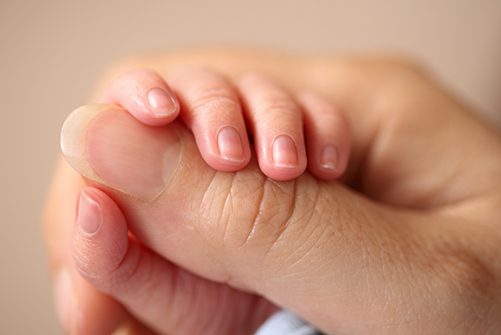
Birth to 3 months
- Recognizes faces, touch, voices, and smell.
- Watches people, objects, and activities intently.
- Recognizes objects within a distance of about 13 inches.
- Follows movement by turning their head.
- Demonstrates anticipatory behaviors like rooting and sucking.

3 to 6 months
- Reaches for, grasps and explores objects with fingers, hands, and mouth.
- Plays “peek-a-boo.”
- Pushes up to see people and things around them.
- Imitates facial expressions.
- Uses both hands to explore toys.

6 to 9 months
- Copies your actions—like waving bye-bye and shaking their head “no.”
- Notices new people and objects in familiar environments.
- Uses several senses at once to explore environment.
- Notices size: reaches with finger and thumb for smaller objects and uses both hands to pick up larger objects.
- Transfers objects smoothly from one hand to the other.
- Looks for things they have dropped.
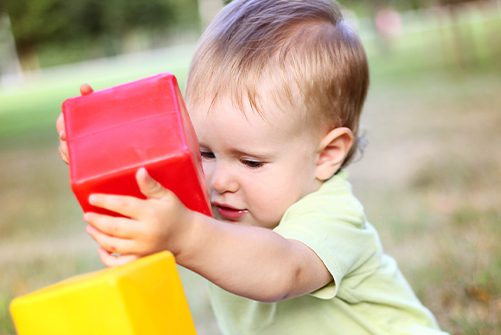
9 to 12 months
- Tries to build a tower with two blocks.
- Figures out how things work through repetition (e.g. dropping his or her toy for you to pick up again and again).
- Uses some objects for their real purpose / function—like a cup for drinking or spoon for eating.
- Connects animals with sounds or actions, such as meowing like a cat or hopping like a bunny.
- Develops stronger memory skills.
- Starts to recognize cause and effect, such as how things fall when they are dropped.

12 to 15 months
- Points to identify a body part or picture.
- Imitates, like talking on a phone or stirring in a pot.
- Begins to solve simple problems—like trying to climb to reach a desired object or to open doors and cupboards.
- Begins following instructions when you use words with gestures: “Bring me that cup” while pointing to the cup.
- Experiments with toys and objects to test what can be done with them.
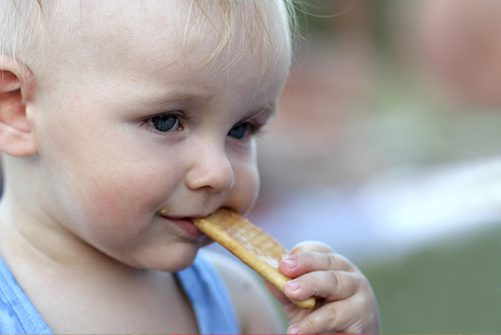
15 to 18 months
- Scribbles with a crayon and builds a tower with blocks.
- Understands simple questions.
- Points to an object when named by caregiver—”Where’s the doggie?”
- Knows the names of some people, body parts, and objects.
- Copies doing chores, such as sweeping and wiping down the counter.
- Begins to play pretend.

18 to 24 months
- Uses imagination (e.g. making noises while playing cars).
- Searches for favorite object.
- Shows some understanding of daily time sequence—like time for nap, lunch, outdoor play.
- Sorts shapes and colors.
- Takes toys apart and puts them back together.
- May recall events that happened days before.
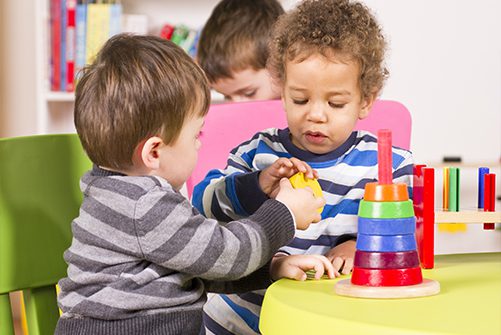
24 to 30 months
- Opens and closes things to see how they work.
- Sorts similar objects together.
- Not always sure what’s real and what’s pretend.
- Laughs at silly stories and actions of others.
- Shows they know colors by pointing to the green crayon when asked, “Where is the green crayon?”
- Holds something in one hand while using the other hand, like holding a container while taking off its lid.
- Tries to use switches, knobs, and buttons.

30 to 36 months
- Does “big kid stuff” like running, riding a tricycle, drawing, or getting dressed.
- Understands spatial concepts like “over” and “under.”
- Explores and notices the way materials can change—like snow melting, water freezing, wind moving leaves.
- Classifies, labels, sorts objects by size, color and/or shape.
- Tries to do most things on their own before asking for help.

3 to 4 years
- Remembers what happened yesterday.
- Builds a tower of six or more blocks.
- Understands the concept of counting and may know a few numbers.
- Recalls parts of a story.
- Engages in imaginative play.
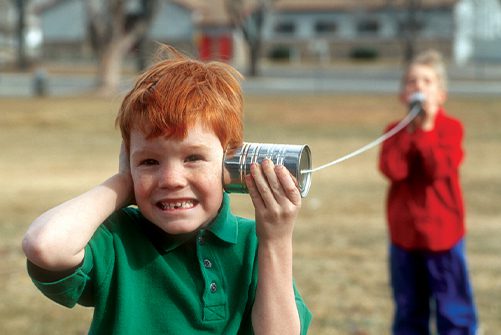
4 to 5 years
- Tries to solve problems.
- Is interested in new experiences.
- Understands “same” and “different” and “behind” and “next to.”
- Follows complex directions.
- Knows about things that are used every day in the home, such as money, kitchen appliances, and tools.
- Talks enthusiastically about things they do.

5 to 6 years
- Uses imagination to create stories, but can distinguish between fantasy and reality.
- Copies a square, triangle, and other geometric shapes.
- Understands the concepts of time and sequential order.
- Knows the seasons.
- Draws recognizable pictures like cars, houses, flowers, and people.
- Begins to reason and argue using words like “why” and “because.”